Motor Archive Jonas Ahola · Finland

Jonas Ahola

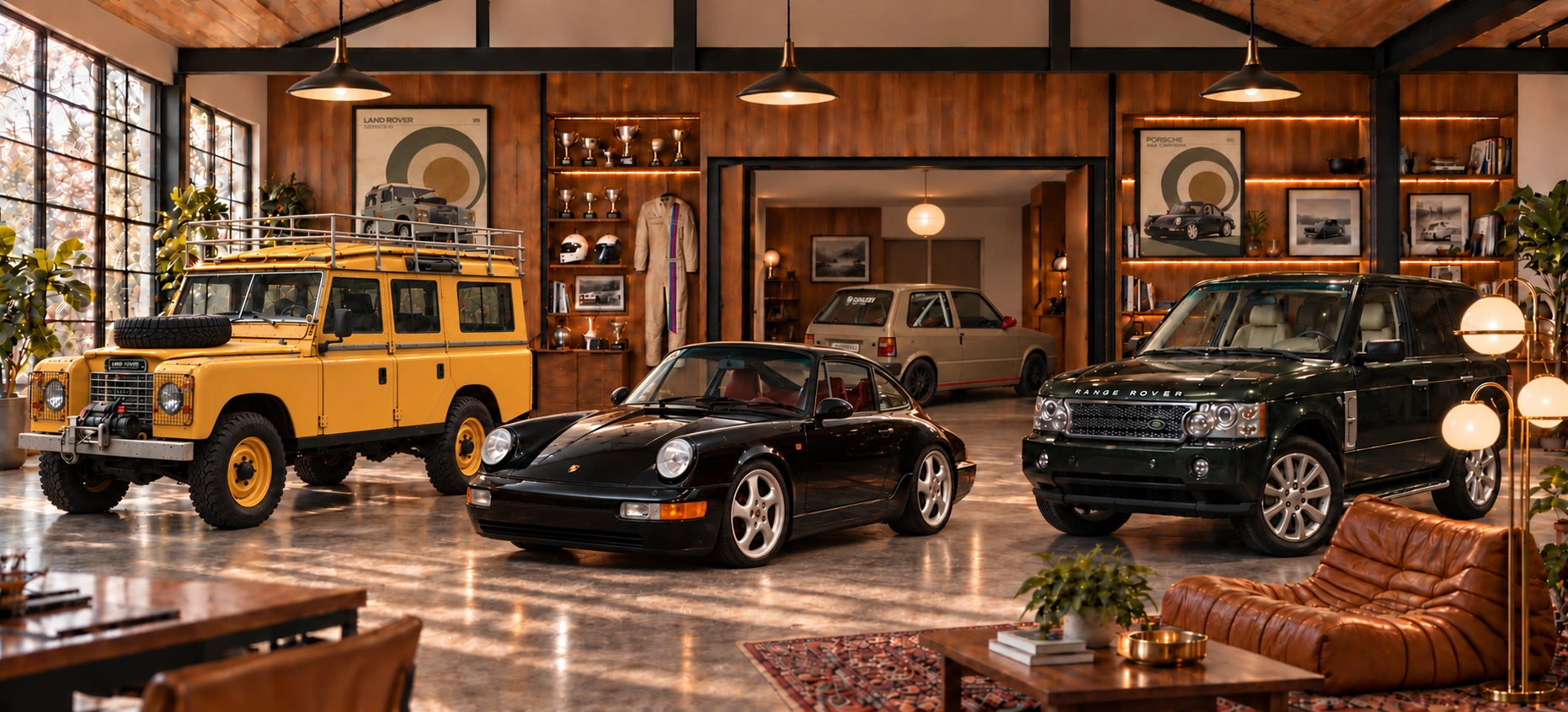
My garage.

Click a car to have a look.Tap a car to have a look.

Swipe to look around · Tap a car to explore

1976 / 1990 / 2008

The road cars.

The Porsche in summer, the Series in the forest, and the Range Rover for family trips and hunting.

See the cars
Also in the garageMy old Fiat Uno Turbo TrophyFrom my racing days. Still here, fully restored.

About the cars

Road cars
and a race car.

The 964 does plenty of miles in summer, and both Land Rovers get their share of country roads. I've also kept the Fiat Uno Turbo Trophy I raced when I was younger. Here are some photos and a few notes about them.

01 / 1976

The Land Rover.

Land Rover Series III · 109 Station Wagon · Camel Trophy inspired

The Series spends most of its time in the countryside. I use it for hunting trips, backroads and going into the forest.

01 / Land Rover · Collector studyAI-created from reference photos · Click to enlarge
01.01 / By the old workshop

My Series III

The long 109.

Mine is the long-wheelbase Station Wagon, with yellow steel wheels to match the body. The spare lives on the bonnet.

Year
1976
Engine
2.25 petrol
Body
109 Station Wagon
Equipment

A full-length roof rack, front winch and lamp guards.

Lights

I've also bought four Hella Rallye 1000 lamps for it.

Camel Trophy: the story & films
See the Land Rover photos

A closer look

A working Land Rover.

What the 109 means.

The number is the wheelbase in inches: the distance between the front and rear axles. It puts this car in the long-wheelbase branch of the Series family. The shorter 88 and the longer 109 share that familiar outline, but the proportions are quite different when you see them side by side.

Mine is the Station Wagon, with a long passenger cabin behind the front seats. The roof rack follows almost the whole length of it. With the spare on the bonnet and the yellow wheels underneath, the long body is easy to recognise.

109-inch chassis · 1976 factory brochure

Steel underneath, aluminium outside.

The Series III kept the basic construction of the early Land Rover: a steel chassis, aluminium body panels and leaf springs. The chassis carries the vehicle, while the separate body is built around it. That is a very different arrangement from the later Range Rover's monocoque structure.

It also explains why an old Land Rover can look remarkably sound on the outside while needing serious work underneath. Aluminium panels do not tell you the condition of the steel chassis and bulkhead. On these cars, the structure matters at least as much as the paint.

Series III history & restoration · Octane

The equipment on mine.

The winch, lamp guards and full-length roof rack give this particular 109 its own appearance. They are separate pieces of equipment you can pick out in the photographs, along with the bonnet-mounted spare and the matching steel wheels.

I've bought four Hella Rallye 1000 lamps for it as well. The Series is used mostly in the countryside, on hunting trips, backroads and visits to the forest. Those are the outings that belong in this part of the archive.

Photographs of my Series III

Camel Trophy / The early years

The Series III
in the jungle.

For a Series III owner, the event to start with is Zaire in 1983. The competing crews drove short-wheelbase 88s. Behind them, the support operation depended on the long 109.

How the yellow convoy began.

Camel Trophy started in Brazil in 1980, using locally built Jeep-type vehicles. Land Rover became involved the following year, when Range Rovers tackled Sumatra. The event grew into a mixture of expedition travel, driving challenges and hard physical work: recovering vehicles, repairing tracks and finding a way through together.

The yellow paint became part of its identity, but the equipment explains just as much of the look. Roof racks, recovery gear and protection were there because the convoy had to keep moving far from a workshop. The photographs made that combination of travel and machinery famous.

The wider Camel Trophy story · 4×4 Afrika

1983: 88-inch crews, 109-inch support.

Seven international crews set off across Zaire, now the Democratic Republic of the Congo, on a route from Kinshasa to Kisangani. The Series IIIs used 2.25-litre diesel engines, with additional cooling equipment for the heat. Roof racks, winches, bridging ladders, steering guards and extra lights completed the expedition preparation.

One episode says a lot about the job. When a fuel truck became stranded, three team vehicles spent the night bringing diesel barrels back to camp. Keeping the whole expedition supplied was as important as getting an individual car through a patch of mud.

The 1983 expedition · Camel Trophy Club

The connection to my 109.

Mine is a 1976 petrol Station Wagon, built before Camel Trophy began. The family resemblance is in the long Series body, the roof rack, the winch and the extra lighting. Its own outings are hunting trips, backroads and the forest, with four Hella Rallye 1000 lamps bought for the next addition.

The following year's event in Brazil used the newer Land Rover One Ten. That makes the 1983 footage a particularly good place to look for the Series III doing the work.

The move to the One Ten · 1984
02 / 1990

The summer car.

Porsche 911 · 964 Carrera 2

I drive the 964 a lot in summer, almost as a daily. We take it on family trips too, and we've been as far as Italy in it.

02 / Porsche · Collector studyAI-created from reference photos · Click to enlarge
02.01 / An evening in the courtyard
02.02 / Burgundy on the road

The burgundy interior.

The seats, carpets and dashboard are all burgundy. It's quite a contrast to the black paint outside. Mine has a manual gearbox.

See the Porsche photos
Year
1990
Engine
3.6 flat-six
Drive
Rear-wheel drive
Cabin
Burgundy · manual

From the photo album

Out with the 964.

Most summer days, this is the car I take. Sometimes it's a family trip all the way to Italy. These are a few photographs from along the way.

Browse the Porsche album
01 / Parked for the eveningView photo
02 / A coffee stopView photo
03 / The road through the mountainsView photo

A closer look

Getting to know the Carrera 2.

Two driven wheels.

The 964 first appeared as the Carrera 4, with four-wheel drive. The Carrera 2 followed in 1989 and sent its power to the rear wheels. That little number is a useful distinction: two cars can look very similar in a photograph while having different drivetrains.

The Carrera's naturally aspirated 3.6-litre flat-six was paired with a five-speed manual or, later, the optional Tiptronic automatic. Mine has the manual. It is the rear-wheel-drive Carrera version, with the engine mounted at the back in the traditional 911 layout.

964 engines & transmissions · Porsche

Twelve plugs, six cylinders.

One of the less visible changes was twin-spark ignition: two spark plugs for each cylinder. Porsche's own history traces the idea back to its work on aircraft engines, where it was developed for greater operating reliability.

It is a good example of how much engineering went into the 964 without changing the outline everyone recognised. Alongside that familiar air-cooled engine were new ignition technology and, in the Carrera 4, a four-wheel-drive system with roots in the 959. The Carrera 2 kept the two-wheel-drive arrangement while sharing the new engine.

The engineering behind the 964 · Porsche

A 911 for longer journeys.

The changes were not all about performance. Porsche fitted a more powerful heater, central locking and electrically height-adjustable front seats. Coil springs replaced the older torsion-bar suspension. These are the sort of details that matter when a car is used regularly and the journey lasts longer than an hour.

That fits the way this one is used. In summer I drive it almost as a daily, and it comes along on family trips too. We've taken it as far as Italy; the black paint and burgundy cabin in these photographs belong to a car that gets driven.

The 964's everyday comforts · Porsche

03 / 2008

Peak Range Rover.

Range Rover L322 · Supercharged Autobiography

The Range Rover gets used for hunting and family trips, as well as getting around in the countryside.

03 / Range Rover · Collector studyAI-created from reference photos · Click to enlarge
03.01 / The L322 in profile

My L322

Green with pale leather.

Mine is a 2008 Supercharged Autobiography. Inside, there's pale leather, wood trim and plenty of proper buttons. The green paint suits it.

Year
2008
Engine
V8 Supercharged
Trim
Autobiography
Colour
Dark metallic green
Interior
Pale leather
See the Range Rover photos
03.02 / From the driver's seat
03.03 / Front seats

From the photo album

Days in the country.

Hunting trips, family trips and getting around in the countryside. These photographs show the Range Rover out in winter, with the tailgate open and a bit of mud on the paint.

Browse the Range Rover album
01 / A winter day in the forestView photo
02 / Tailgate openView photo

A closer look

The details behind the names.

Where Autobiography began.

Autobiography was announced at the London motor show in late 1993, with the first customer cars following in 1994. The original idea was personalisation: buyers could choose unusual paint colours and interior finishes through a dedicated team.

By the L322 era, the choices extended to details such as cabin wood and even the colour of the sheepskin rugs. An earlier piece of publicity offered space for a fax machine in the rear console, which dates the idea rather neatly. This history belongs to the Autobiography programme; my own car's green paint and pale leather are shown above.

Land Rover's anniversary release · reproduced by Ovalnews

The Supercharged part.

Autobiography describes the specification; Supercharged describes how the V8 gets its extra air. A mechanically driven compressor supplies pressurised intake air to the engine. Its drive comes from the engine itself, which is the central idea behind this kind of supercharging.

The appeal is response across a wide engine-speed range. Eaton explains this principle through its supercharger technology: boost can be available from low revs, with a predictable build-up of power. It helps explain why mechanical supercharging has been used in large road-car engines as well as much smaller applications.

How mechanical supercharging works · Eaton

The dial between the seats.

Terrain Response gives the driver a general road setting and programmes for Grass–Gravel–Snow, Mud–Ruts, Sand and Rock Crawl. The names describe the surface rather than asking the driver to adjust each system separately.

The distinction between firm ground covered in loose material and deep, soft sand is particularly useful. They need different responses from the car. Rock Crawl, meanwhile, is available only in low range. The handbook shows just how much thought went into the controls beneath that comfortable cabin. My Range Rover is used for hunting, family trips and time in the countryside.

Terrain Response explained · Land Rover handbook

04 / Fiat Uno Turbo Trophy

The one I raced.

I raced this Uno when I was younger. The old photograph shows it in action as No. 54. I still have the car today, fully restored.

54
Then / On track · No. 54Click to open
Now / Fully restoredStill mine
Competition interiorCage, buckets & harnesses

My name is on the rear window in the old photo, with Ahola Transport on the door. Today it still feels like a proper race car inside: roll cage, bucket seats and red harnesses.

See the Uno photos

Uno Turbo Trophy / Finland

The Finnish Trophy years.

The Uno Turbo had a Finnish racing series of its own. Driver Database's archive records Janina Eräkangas at the top in 1989 and Tapio Virtanen in 1990, then lists me in position 1 for 2000. Together, the three seasons offer a glimpse of the competition behind the Trophy name.

1989Championship top three
Pos.DriverPoints
1Janina Eräkangas66
2Tapio Virtanen53
3Arto Salmenautio45
1989 standings · Driver Database
1990Championship top three
Pos.DriverPoints
1Tapio Virtanen61
2Michael Westman51
3Ari Mäkinen42
1990 standings · Driver Database

From the Trophy to touring cars.

Arto Salmenautio's career connects the Uno Trophy with Finland's later touring-car scene. After third place in the 1989 Trophy standings, Driver Database records him as runner-up in the Finnish Group A championship's over-2,000 cc class in 1991, driving a BMW M3.

In 1998 he won the Sport 2000 Tour with OS Motorsport in a BMW 320i. He finished second in the series in both 1999 and 2000. His results put one of the Trophy's front-runners into the wider story of Finnish circuit racing.

Arto Salmenautio's racing record · Driver Database

The Uno in FIA's archive.

The FIA Historic Database lists the Uno Turbo IE under Group A homologation number 5278, dating from 1985. The record identifies a four-cylinder, front-wheel-drive model and includes extensions covering rollbars, brakes, transmission and suspension.

This is a reference for the model's competition background. The detailed specification of a Finnish Trophy car depends on the period series rules and the car's own competition papers.

Homologation 5278 & extensions · FIA Historic Database

A closer look

The Uno, then and now.

A small engine with plenty going on.

The original road-going Turbo had Bosch injection, Magneti Marelli ignition, an IHI turbocharger and an intercooler. Its five-speed gearbox came from the Ritmo 105 TC.

Fiat also fitted ventilated front discs and a fibreglass tailgate with a spoiler. These are production-car details; the Trophy car has its own competition specification.

The original Turbo's development · Stellantis Heritage

The road car changed, too.

The second-series Turbo arrived in 1989 with a 1,372 cc engine and Garrett T2 turbo. Fiat quotes 116 hp, or 112 hp with a catalytic converter. The Punto GT succeeded it after production ended in 1994.

Those figures describe the road models, not the power of my restored race car.

Two generations of Uno Turbo · Stellantis Heritage

Look closely at No. 54.

The old racing photograph is worth opening at full size. There are red wheels, a red mirror and a big 54 on the door. My name appears on the rear side window, with Ahola Transport among the lettering on the body. The blurred background catches the car in motion.

In the newer garage photograph, the car has black wheels and much less lettering on the body. Inside, the white cage runs around the black bucket seats and red harnesses. These photographs show two different points in the same car's life. I raced it when I was younger, and I still have it, fully restored.

Open the racing & restoration photographs

Moving pictures

Out there.

Some days are better remembered in motion: the Series in the snow, the 964 on the road, the Range Rover leaving it behind and the restored Uno starting in the workshop.

Series IIIA winter drive.Snow, open fields and the old 109.
964 Carrera 2Seen from the next car.A short spring drive.
L322 AutobiographyAcross the field.Where the road ends.
Fiat Uno Turbo TrophyStartup after renovation.A workshop walkaround and the sound of the restored car.

Press play for the original clips and sound.

A few more photos.

Books & archives

A little
further reading.

For the details that don't fit in a caption: books, museum records, factory histories and the manuals that explain how the cars work.

  1. Land Rover · Workshop reference

    Land Rover Series II, IIA and III Restoration Manual

    Emrys Kirby · The Crowood Press

    For getting to know a Series properly: bodywork, chassis repairs, mechanical rebuilds and which parts fit across the generations.

    About the book
  2. Porsche · Illustrated history

    Porsche 911 60 Years

    Randy Leffingwell · Motorbooks

    The wider 911 story, told through individual cars and archive photography. Includes the 964 Carrera RS and the people behind the design.

    About the book
  3. Range Rover · Model history

    Range Rover Third Generation: The Complete Story

    James Taylor · The Crowood Press

    Devoted to the L322, from its BMW-era beginnings to the changes over its life. Covers the engineering, colours, interiors and ownership details.

    About the book
  4. Fiat Uno Turbo · Factory archive

    Forty years of the Uno Turbo i.e.

    Stellantis Heritage · 2025 · Online article

    Fiat's account of the road car's development, its two generations and a test drive by Ferrari Formula One driver Michele Alboreto.

    Read the article
  5. Land Rover · Museum archive

    The final Series III 109

    British Motor Museum · Online collection

    The museum record for the last Series III built at Solihull: a 1986 export-model 109, with specifications and a concise history of the model.

    Open the museum record
  6. Porsche 964 · Factory history

    The type 964: a new start with this 911

    Porsche Newsroom · Online article

    Porsche's compact history of the 964 covers the 959-derived four-wheel drive, twin-spark flat-six, retractable spoiler and the rarer Jubilee and Speedster versions.

    Read at Porsche Newsroom
  7. Range Rover L322 · Owner's handbook

    The 2008 Range Rover manual

    Land Rover Technical Communications · 2008 · PDF

    The original guide to the air suspension, Terrain Response, low-range gearbox and the many cabin controls. Its specifications also make useful reference reading.

    Open the owner's handbook
Photo archive

Swipe or use arrow keys to browse · Esc to close